Global fiber deployment is accelerating, but purchasing decisions remain uneven across regions. The OECD Broadband Statistics report found that fiber accounted for about 42% of fixed broadband connections across OECD economies in December 2023. Meanwhile, the FTTH Council Global Alliance continues to report strong growth in fiber-to-the-home coverage worldwide. These figures create demand for practical infrastructure products, including 25mm Red Ducting.
A red outer jacket helps crews identify communications routes quickly. It does not prove product quality. Buyers must check internal diameter, wall thickness, HDPE grade, pulling strength, crush resistance, UV stability, and operating temperature. Installation conditions matter too. A duct that performs well in a clean trench may fail near sharp aggregate or repeated road loading. Supplier documentation should include test methods, batch traceability, and compliance statements for the destination market.
Gary Bolton, President and CEO of the Fiber Broadband Association, has stated, “Fiber is the only technology that can meet the bandwidth needs of the future.” That view explains the importance of dependable duct protection, not merely faster cable. This guide compares ten 25mm Red Ducting suppliers for global buyers, considering manufacturing capacity, export experience, product consistency, customization, and technical support. The ranking is useful, but not final. Prices change. Certifications expire. Even a trusted supplier may not suit every soil type or installation method. Careful buyers should request current samples and independent test evidence before placing large orders.
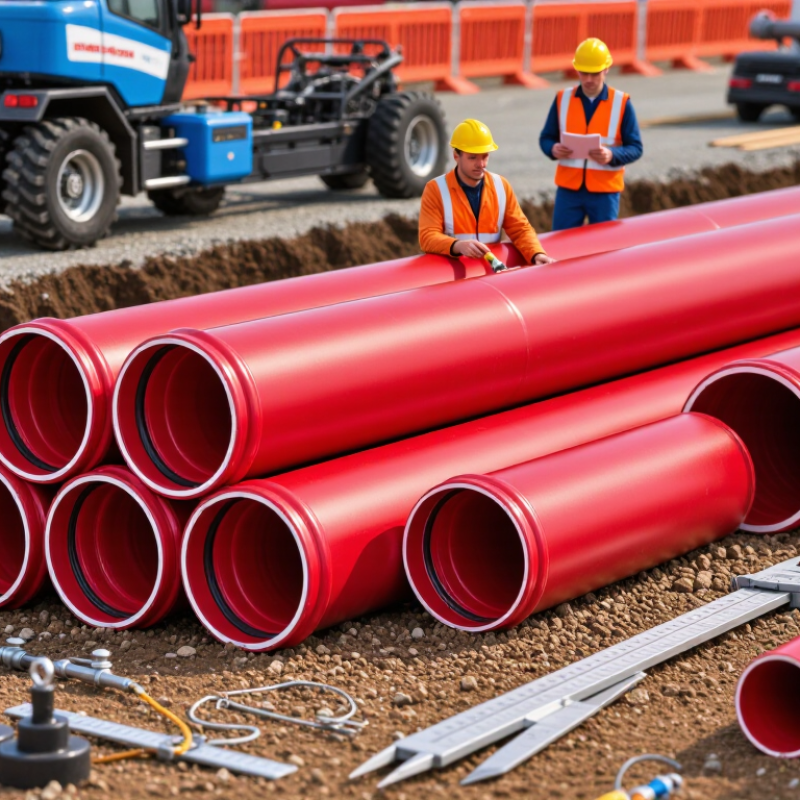
Top 10 25mm Red Ducting Suppliers for Global Buyers
What 25mm Red Ducting Is and Why Global Buyers Use It
25mm red ducting is a protective tube for routing electrical or communication cables. The 25mm measurement may describe its nominal internal or external diameter. Buyers must verify this detail before ordering. Red commonly identifies power-related services in some markets, but color codes are not universal. Always check local project specifications.
The ducting may use HDPE, PVC, or polypropylene. Corrugated designs bend around corners, while smooth walls support easier cable pulling. Common requirements include crush resistance, UV stability, flame behavior, and a suitable temperature range. IEC 61386-24 covers conduit systems for buried cable protection. Compliance evidence matters more than a bright color.
The International Energy Agency’s Electricity 2024 report expects global electricity demand to grow by about 3.4% annually through 2026. The ITU reported 5.4 billion internet users in 2023. These trends support expanding cable networks, although they do not guarantee demand for every duct size. I have seen projects fail when installers checked diameter but ignored pulling distance and bend radius.
Tips: Request test reports, wall-thickness data, and sample lengths. Confirm whether 25mm is internal or external. Check UV exposure, burial depth, and connector compatibility. Color alone is not enough.
Anonymized supplier comparison based on commonly specified product formats, international purchasing requirements, and application suitability. “25mm” refers to the nominal ducting diameter; buyers should confirm whether the quoted size is internal or external diameter.
| Rank | Supplier Profile | Primary Supply Region | Common 25mm Red Ducting Format | Typical Material Options | Common Product Length | Key Buyer Requirements Supported | Typical Applications | Commercial Suitability | Selection Score |
|---|---|---|---|---|---|---|---|---|---|
| 1 | Supplier Profile A | East Asia | Flexible red corrugated conduit, nominal 25mm | UV-stabilized polyethylene or polypropylene | 25m or 50m coils | OEM color matchingExport cartonsBulk pricing | Telecom cable protection, low-voltage cable routing, general utility work | Strong option for high-volume container orders | 9.2/10 |
| 2 | Supplier Profile B | South Asia | Red split conduit with longitudinal opening | Flexible PVC or polyethylene | 10m, 25m, or 50m coils | Low-MOQ optionsPrivate labelingMixed-size orders | Repair work, retrofit installations, harness protection, equipment wiring | Suitable for distributors requiring flexible order quantities | 8.9/10 |
| 3 | Supplier Profile C | Central Europe | Heavy-duty smooth or lightly corrugated red conduit | High-density polyethylene or halogen-free polyolefin | 25m or 50m coils | Technical datasheetsTraceabilityConsistent dimensions | Industrial control cables, machinery wiring, building services | Good fit for specification-led procurement | 8.8/10 |
| 4 | Supplier Profile D | North America | Red flexible cable-protection tubing, nominal 25mm | Flame-retardant PVC or flexible polyamide | 15m or 30m coils | Regional stockCut lengthsFast replenishment | Panel building, automation, maintenance, indoor cable management | Useful for time-sensitive regional orders | 8.6/10 |
| 5 | Supplier Profile E | Southeast Asia | Red underground cable duct, flexible or semi-rigid | Polyethylene, often with carbon-black UV protection in black layers | 50m or 100m coils | Outdoor useContainer loadingWeather-resistant options | Outdoor communications, solar wiring, utility and landscaping projects | Competitive for project-based outdoor applications | 8.5/10 |
| 6 | Supplier Profile F | Middle East | Red protective conduit for electrical and communication cables | UV-resistant PVC or polyethylene | 25m or 50m coils | Hot-climate optionsOutdoor packagingProject quotations | Construction, building services, security systems, external wiring | Appropriate where heat and sunlight exposure matter | 8.3/10 |
| 7 | Supplier Profile G | Eastern Europe | Flame-retardant red flexible conduit | Flame-retardant PVC or halogen-free thermoplastic | 10m, 25m, or 50m coils | Indoor safety focusSmall-batch productionCompliance files | Commercial buildings, control cabinets, public infrastructure | Best for buyers prioritizing documentation and safety properties | 8.1/10 |
| 8 | Supplier Profile H | Latin America | Red corrugated conduit for low-voltage and data cables | Flexible PVC or polyethylene | 25m or 50m coils | Distributor packsMixed SKUsRegional delivery | Residential construction, data cabling, electrical maintenance | Practical for local distribution and mixed-product purchasing | 7.9/10 |
| 9 | Supplier Profile I | Oceania | Heavy-wall red conduit for cable identification and protection | UV-stabilized polyethylene or PVC | 25m, 50m, or 100m coils | Outdoor gradesLong-length coilsProject supply | Utility corridors, renewable-energy projects, outdoor communications | Suitable for remote projects requiring longer coil lengths | 7.8/10 |
| 10 | Supplier Profile J | North Africa | Economy-grade red flexible conduit for general cable protection | PVC or standard polyethylene | 10m, 25m, or 50m coils | Cost-focused supplyBasic customizationBulk orders | General electrical installation, maintenance, and non-critical routing | Cost-effective where environmental exposure is limited | 7.6/10 |
It protects electrical or communication cables during routing, burial, and installation. It can reduce crushing and surface damage.
Not always. It may describe the nominal internal or external diameter. Confirm this detail before ordering.
Red may identify power-related services in some markets. Color meanings differ globally. Check the local project specification.
Common options include HDPE, PVC, and polypropylene. Material choice affects flexibility, durability, temperature range, and flame behavior.
Corrugated ducting bends around corners more easily. Smooth walls can support easier cable pulling. The better choice depends on the route.
Request test reports, wall-thickness data, tolerance details, and sample lengths. Evidence matters more than appearance.
Check material grade, packaging, inspection documents, tooling, and replacement allowances. The lowest quote may exclude important costs.
Ask about production capacity, port location, lead time, stock levels, and inspection procedures. Custom lengths may need extra weeks.
Measure the internal diameter, surface finish, wall thickness, and bending recovery. Check whether the duct remains stable after bending.
Confirm pulling distance, bend radius, UV exposure, burial depth, and connector compatibility. Diameter alone is not enough. I have learned that late.
This guide presents a practical overview of 25mm Red Ducting and explains why it is widely selected by global buyers for organized cable routing, equipment protection, and efficient installation work. It covers the main product characteristics, including internal diameter, wall strength, flexibility, temperature resistance, color consistency, flame performance, packaging, and compatibility with common fittings. Buyers will also learn how to assess supplier reliability through production capacity, quality-control procedures, customization options, documentation, and communication efficiency.
The article introduces ten supplier types based on product specialization and market focus, without promoting specific brands. It compares how leading suppliers may differ in material quality, pricing structures, minimum order quantities, lead times, export experience, and after-sales support. A final purchasing checklist helps international customers confirm technical requirements, request samples, review inspection procedures, calculate total landed cost, and verify delivery arrangements. By considering these factors together, buyers can select a dependable source of 25mm Red Ducting that matches their application, budget, and long-term supply expectations.

 Kingflex