 Kingflex
1 / 1
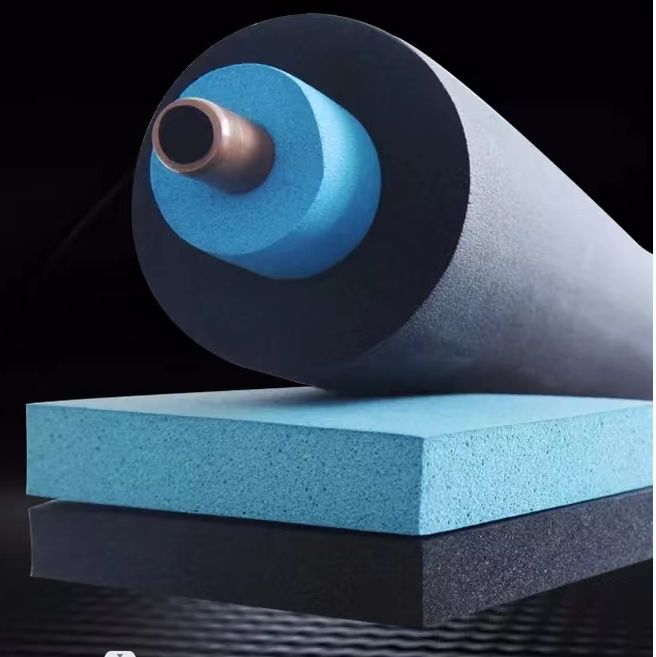
The impact from any part can be widely dispersed and attenuated by elastomer material, thus avoiding the risk of cracking due to stress concentration. Additionally, reducing the temperature change stress makes this cooling system superior to traditional materials such as foam glass, polyurethane PIR, and PUR.
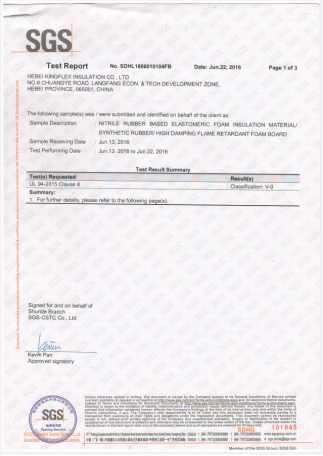
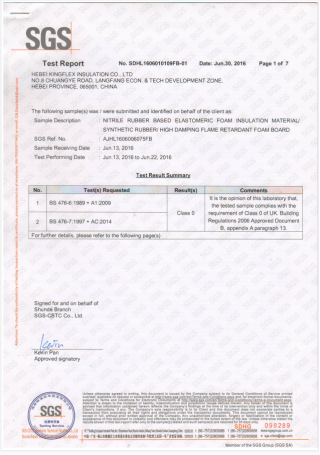
| Property | Base material | Standard / Test Method | |
|---|---|---|---|
| ULT Grade | LT Grade | ||
| Thermal Conductivity | -100°C, 0.028 -165°C, 0.021 |
0°C, 0.033 -50°C, 0.028 |
ASTM C177 |
| Density Range | 60-80Kg/m³ | 40-60Kg/m³ | ASTM D1622 |
| Recommend Operation Temperature | -200°C to 125°C | -50°C to 105°C | — |
| Percentage Of Close Areas | >95% | >95% | ASTM D2856 |
| Moisture Performance Factor | NA | <1.96x10g(m.m.Pa) | ASTM E 96 |
| Wet resistance Factor μ | NA | >10000 | EN12086 / EN13469 |
| Water Vapor Permeability Coefficient | NA | 0.0039g/h.m² (25mm thickness) |
ASTM E 96 |
| PH | ≥8.0 | ≥8.0 | ASTM C871 |
| Tensile Strength Mpa | -100°C, 0.30 -165°C, 0.25 |
0°C, 0.15 -50°C, 0.218 |
ASTM D1623 |
| Compressive Strength Mpa | -100°C, ≤0.3 | -40°C, ≤0.16 | ASTM D1621 |
The flexible ULT insulation system does not require the use of fiber materials as expansion and contraction fillers (a construction method typical for rigid foam LNG pipes).
| Product Dimensions | |||
|---|---|---|---|
| Inches | mm | Size (L * W) | ㎡ / Roll |
| 3/4" | 20 | 10m × 1m | 10 |
| 1" | 25 | 8m × 1m | 8 |

Elastomer materials excel at dispersing and absorbing physical impacts. This minimizes the risks of stress-concentration cracking and helps manage thermal expansion and contraction stress better than traditional rigid options like PIR, PUR, or foam glass.
No. Unlike rigid foam LNG piping insulation systems, the flexible ULT insulation system does not require additional fiber materials to serve as expansion and contraction fillers, simplifying installation and maintenance.
The ULT Grade is optimized for extreme cryogenic operations from -200°C to 125°C, while the LT Grade is designed for standard low-temperature conditions ranging from -50°C to 105°C.
According to ASTM C177 testing standards, the ULT Grade achieves a low thermal conductivity of 0.028 W/(m·K) at -100°C, and drops further to 0.021 W/(m·K) at -165°C, ensuring high thermal performance.
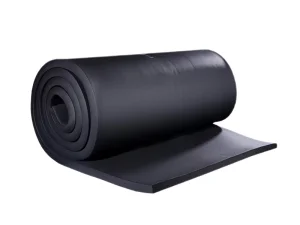
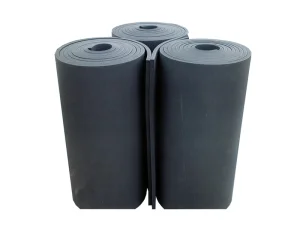
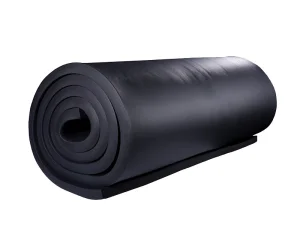
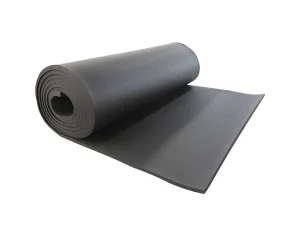
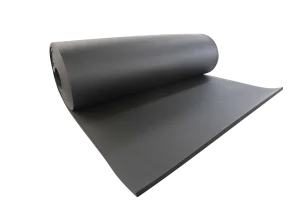
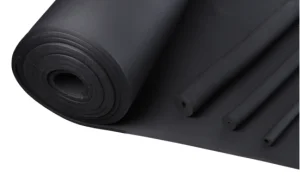
The flexible insulation comes in rolls with standard sizes of 10m x 1m for the 3/4" (20mm) thickness and 8m x 1m for the 1" (25mm) thickness option.