 Kingflex


1 / 2
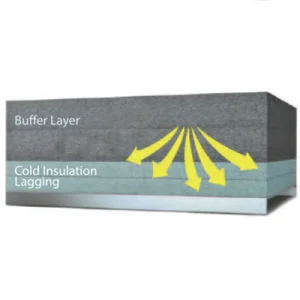
The flexible ultra-low temperature adiabatic system has the inherent characteristics of impact resistance, and its cryogenic elastomer material can absorb the impact and vibration energy caused by the external machine to protect the system structure.
This feature of the product greatly extends the life of the entire cold insulation system and significantly reduces the risk of corrosion of the pipes under the insulation.
The flexible ULT insulation system does not require the use of fiber material as expansion and contraction fillers.
LNG; Large-scale cryogenic storage tanks; Ethylene projects, Nitrogen plant; Coal chemical industry…
| ULT Technical Data | ||
|---|---|---|
| Property | Unit | Value |
| Temperature range | °C | (-200 - +110) |
| Density range | Kg/m³ | 60-80Kg/m³ |
| Thermal Conductivity | W/(m.k) | ≤0.028 (-100°C) |
| ≤0.021 (-165°C) | ||
| Fungi resistance | - | Good |
| Ozone resistance | - | Good |
| Resistance to U.V. and weather | - | Good |

The system features an operating temperature range of -200°C to +110°C, making it suitable for ultra-low temperature applications.
The cryogenic elastomer material of the adiabatic system inherently absorbs impact and vibration energy from external machinery, securing the integrity of the pipe and system structures.
It significantly reduces the risk of corrosion of the pipes under the insulation. By preventing moisture ingress, it extends the overall lifespan of the entire cold insulation layout.
No. The flexible ULT insulation system includes a built-in expansion joint feature, eliminating the need for extra fiber materials as expansion and contraction fillers.
The material delivers low thermal conductivity, measured at ≤0.028 W/(m.k) at -100°C and ≤0.021 W/(m.k) at -165°C, ensuring optimal energy savings.
It exhibits high durability with rated "Good" resistance to fungi, ozone, ultraviolet (U.V.) light, and varied outdoor weather conditions.